Watch: BCRS Plastic Bottle System Is A Tax On People, Simon Mercieca Warns

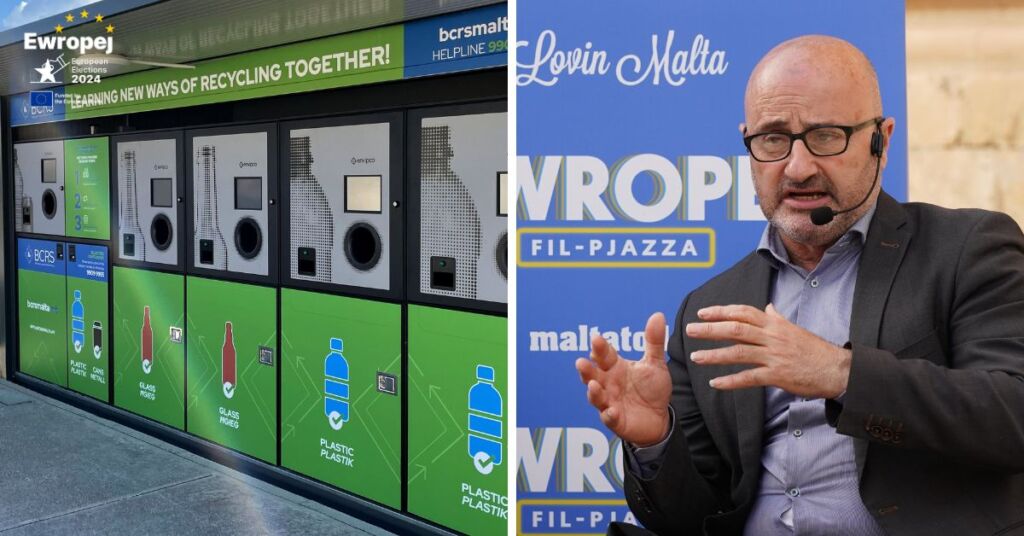
Independent MEP candidate Simon Mercieca has warned that the BCRS plastic bottle reverse vending machines have imposed a “tax” on regular people.
“Climate change is being used to oppress people further, particularly those at the bottom,” Mercieca said yesterday during an Ewropej fil-Pjazza debate in Mosta that Lovin Malta and MaltaToday organised.
“Many measures are being introduced. Properties have become more expensive because they need to be energy efficient, and we are spending a lot of money to make Castille and other places energy efficient. I’m not talking against the environment but against the measures.”
The candidate, a history lecturer at the University of Malta, went on to criticise the BCRS system that was introduced last year.
“The reality is that people at the bottom now have to pay an extra tax for water and life has become 10% more expensive,” he said. “When you deposit the bottles, they only give you your money back through a receipt, whereas in the past you would receive 2c for a bottle.”
“This system is actually helping the BCRS, because the 10% charge on all the bottles that aren’t deposited end up in their pockets. This is the truth.”
ADPD candidate Ralph Cassar stressed that the ultimate goal should be eliminating plastic bottles entirely and criticised large European political groups like the EPP for voting against climate change directives at the European Parliament.
PL candidate Steve Ellul stressed that climate change measures should focus more on the “carrot” than the “stick”.
“We cannot use EU laws to penalise families, self-employed and businesses, and as socialists we must stress the point further that we need to incentive ecological transition,” he said.
Ellul noted that the Maltese government has introduced incentives, through grants and low charging tariff rates, to encourage people to purchase electric cars and said the strategy is working.
“No one used to buy electric cars before these incentives, but now 60% of new cars on the road are electric,” he said. “The EU needs to absorb this ideas that accelerating ecological transition shouldn’t be at the cost of economic progress, but that we should incentivise families, businesses and self-employed people to be the driving force themselves.”
This action was co-financed by the European Union in the frame of the European Parliament’s grant programme in the field of communication. The European Parliament was not involved in its preparation and is, in no case, responsible for or bound by the information or opinions expressed in the context of this action. In accordance with applicable law, the authors, interviewed people, publishers or programme broadcasters are solely responsible. The European Parliament can also not be held liable for direct or indirect damage that may result from the implementation of the action.
READ NEXT: Norman Vella Awarded €15,000 After Court Finds He Was Fired From PBS Due To Political Discrimination
